 FSM-Nail


Search the entire website
Search
Search the entire website
The safest way to deal with glue overflow is to trim it with fine sand strips or high-quality grinder heads, which is a very routine operation in the industry.
Before dealing with the spilled glue, use a cleaning brush dipped in 70% alcohol to clean the residual glue or floating ash on the finger edge, which can help you see clearly where there is an extra piece. Next, gently sand the edges at a 45-degree angle with a 180 or 240-purpose strip of fine sand. This angle is very critical, it can make a smooth transition between the glue layer and the nail surface, otherwise it will not only become warped easily in the future, but also hide dirt.
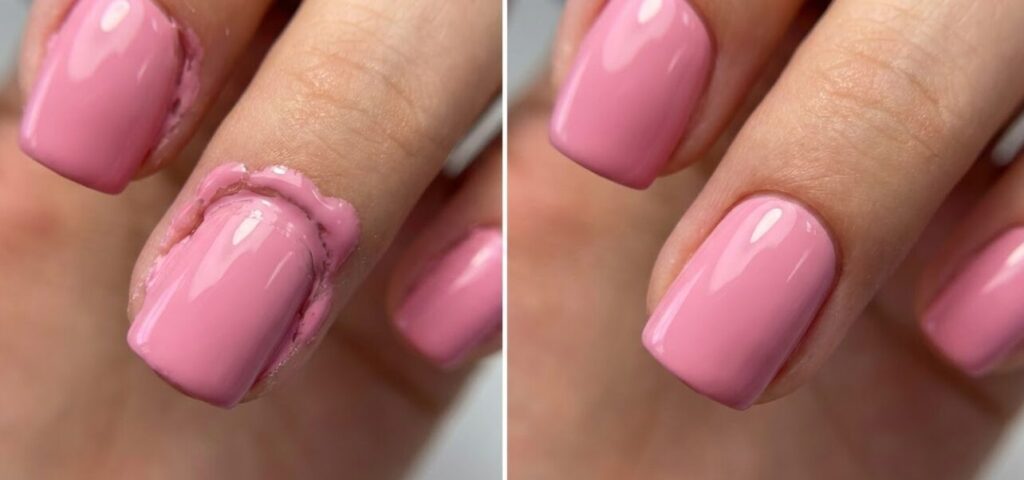
Usually because the primer or color glue is applied too close to the trailing edge or sidewall. Once the light hardens, the overflowing glue will form a “hillside”, which is not only ugly, but also makes it easier for the subsequent seal to crack. Therefore, timely cleaning after lighting is not only to look good, but also to extend the service life of manicure.
Before starting work, make sure the workbench is clean and the tools are sterilized. You need:
70% isopropyl alcohol: must have, used to remove floating glue and clean the nail surface.
Fine sand strip (180/240 mesh): It is recommended to use 240 mesh, which is more friendly to the skin and is not easy to break the skin.
Sanding machine (advanced optional): If you are skilled in using the machine, equipped with a precise small flame head is an artifact to clean the finger edge.

Clean the nail surface: use non-woven fabric or soft brush dipped in alcohol, carefully wipe the edge of the nail 1 times. This step is to make your vision clear and see the dividing line between the overflow glue and the skin.
Hand grinding: when holding the sand bar, the hand must be steady and maintain a 45-degree bevel. The key point is to smooth the transition. Don’t rub your skin.
Grinder cleaning (advanced version): Remember, the speed must be low (5000-8000 rpm or less) to avoid heat accumulation and scalding the nail bed. Gently walk the flame head along the side wall 1 times, avoiding the nail surface and moving in the direction of rotation so that it does not “drag” the skin.
In order to reduce the trouble of finishing later, I usually follow several principles when doing manicure for guests:
Thin coating: the thicker the glue pile, the easier it will flow to the finger edge.
Reserve “breathing line”: when applying, leave a gap of about 1mm at the edge of the nail groove. Anyway, the nail will grow, and the distance will disappear when it grows in the later period. The key is that it can completely prevent the glue from touching the skin.
Stage pre-lighting: If you are afraid of the glue running around before entering the light, you can do a single-finger flash (10 seconds) first, fix the shape and then set the light.
Author: Chloe Evans
As a professional nail technician with over seven years of experience in gel manicures, I specialize in precision application and nail health. I’ve helped countless clients and DIY enthusiasts master the art of the perfect finish. I’m passionate about sharing technical tips—like how to safely refine cured edges—to ensure everyone can achieve a flawless, salon-quality manicure at home without compromising their natural nail integrity