 FSM-Nail


Search the entire website
Search
Search the entire website
The simple and direct answer is: no, gel nail polish absolutely cannot “natural dry.”
This must be made clear: ordinary nail polish depends on volatile drying after air contact, but real nail polish needs to go through a chemical process called “curing” to harden. This reaction is only triggered by UV or LED light of a specific wavelength.
If there is no light, the photoinitiator in the nail polish formulation will always be in a “dormant” state. This means that even if you leave your hands there for hours or even days, the surface of your nails is still wet and sticky, and the slightest touch will become a mess.
Don’t try to blow with your mouth, soak in cold water, or sit around; these physical means cannot turn the liquid glue into a hard coating. What’s more serious, if uncured nail polish is left on the skin or nails for a long time, it can greatly increase the risk of developing contact dermatitis (a lifelong allergic reaction).
To understand why we can’t dry and wait for the nail polish to dry, we need to understand the difference between it and traditional nail polish in the underlying chemical logic.
This stuff is solvent-based. When you apply it to your nails, the solvent (liquid part) inside starts to evaporate into the air. As the solvent disappears, the remaining solid pigment and resin harden into a film. This is purely a physical change, just like water dries and leaves a water stain.
Its formulation is based on polymers, containing components called “oligomers” and “monomers.” These molecules are not volatile. Instead, they must be linked together hand in hand to form a rigid plastic mesh structure. This process is chemically called “polymerization.”
Because there are no volatile solvents in the polish gel, it does not have any “drying” mechanism in the air. It is designed to remain liquid until a specific hardening signal is received.
The “signal” that commands the polish to harden comes from a photoinitiator. Every bottle of nail polish is mixed with this light-sensitive compound.
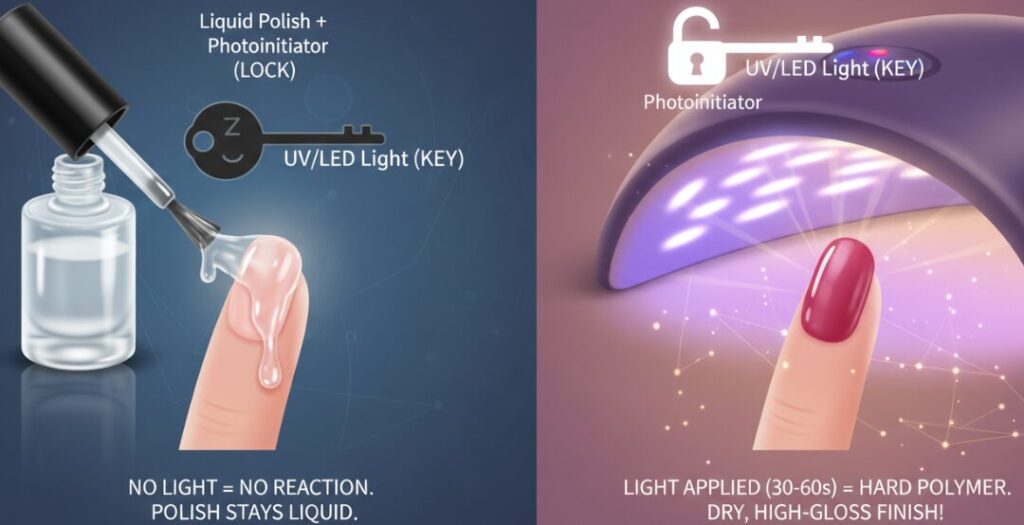
You can think of the photoinitiator as a lock, and the UV or LED nail light is the key.
When light of a specific wavelength from a light fixture hits a photoinitiator, they absorb energy.
This energy instantly (usually within 30 to 60 seconds) converts the liquid oligomer into a hard polymer.
You get a long-lasting, high-gloss surface that is completely dry to the touch.
Without the concentrated light from the nail lamp, the photoinitiator will always sleep, and the nail polish will always be liquid.
I can’t. A hair dryer only provides wind and heat. Since the polish gel does not evaporate and dry, the flowing air does not help except to blow the dust in the air onto your wet nails. As for hot air? That will only make the gel thinner, causing it to flow into your nail groove, but it will never make it hard.
I can’t. Soaking uncured nails in ice water may make the gel feel a little harder due to a sudden drop in temperature (like butter in a refrigerator that hardens), but it doesn’t change its chemical structure. As long as your hands warm up, your nails will immediately return to a wet, messy state.
Technically, sunlight does contain UV rays, so it does eventually cure the polish. However, I highly recommend against this for 3 reasons:
When the nail polish is in an uncured (wet) state, it contains large amounts of free monomers (such as HEMA), small molecules that can penetrate into the skin. If you try to let the polish gel “dry naturally” and let it touch your skin or dead skin for a long time, your immune system may recognize these chemicals as allergens.
This can lead to contact dermatitis, the symptoms of which include:
Once you develop an allergy to these acrylates, it’s usually lifelong. This means that you may not be able to make any more nail polish or crystal nail for the rest of your life.
Therefore, be sure to use the right lamps and lanterns to cure the nail polish immediately; do not try to let it dry naturally.
Author: Sarah Jenkins
“Hi, I’m a licensed nail technician with over 10 years of experience in the beauty industry. I specialize in gel chemistry and natural nail health. My passion is demystifying professi.