 FSM-Nail


Search the entire website
Search
Search the entire website
No, gel nail polish does not dry on its own through air-drying like regular nail polish does.
The reason why ordinary nail polish dries is because the solvent in it volatilizes in the air, and finally the remaining pigment layer hardens. But the composition of the polish is completely different. It contains special molecules called “photoinitiators.” These molecules are very sensitive to light and only react chemically when exposed to light of a specific wavelength. This process is professionally called “polymerization,” that is, through the UV lamp or LED lamp, the liquid colloid into a hard, wear-resistant plastic coating.
If you don’t plan to use professional lighting equipment, this layer of glue will always remain liquid or semi-liquid. Whether you wait a few hours, blow a fan, or exhale with your mouth, the surface of your nails will definitely rub on.
To understand why nail polish can’t dry, we have to look at its “foundation.” Ordinary nail polish is solvent-based, but gel nail polish is actually a mixture of acrylic monomers and oligomers.
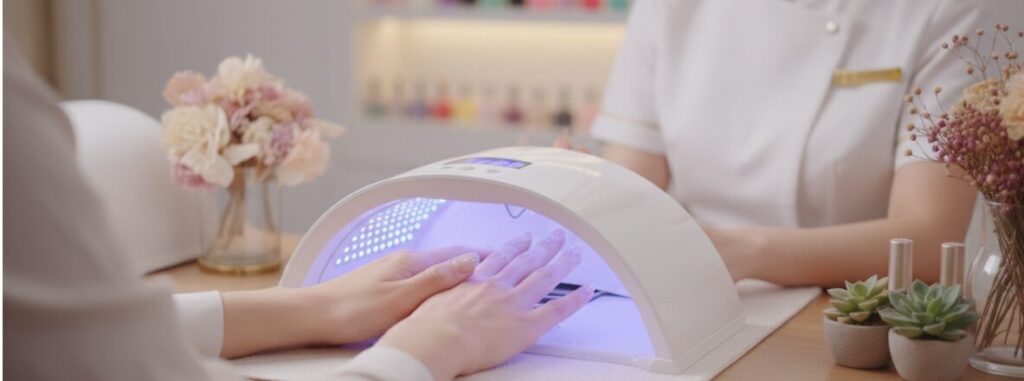
These ingredients are stable when in the bottle, but once activated by a specific catalyst, they will quickly lock together like a buckle chain. This catalyst is UV (ultraviolet) or LED light. When light hits the photoinitiator on the nail polish, it triggers a chain reaction that turns the otherwise loose liquid molecules into a cross-linked structure, forming a strong, solvent-resistant plastic.
Without that lamp, this reaction would not have started at all. Therefore, the nails are left to dry outside the lamp for hours or even days, and the results are the same, still “wet.”
Since it is necessary to have a light source, what is the difference between these two types of equipment on the market?
Regardless of the technology, the core principle is to provide the energy needed to form chemical bonds. I often see people try to use a hair dryer (even if it is a cold wind) or a small fan on the table. It is useless. These things can only move air and do not provide the electromagnetic radiation that can cause polymerization.
Many DIY nail lovers like to find alternatives to lights, but from a chemical point of view, the following “black technology” are basically pits:
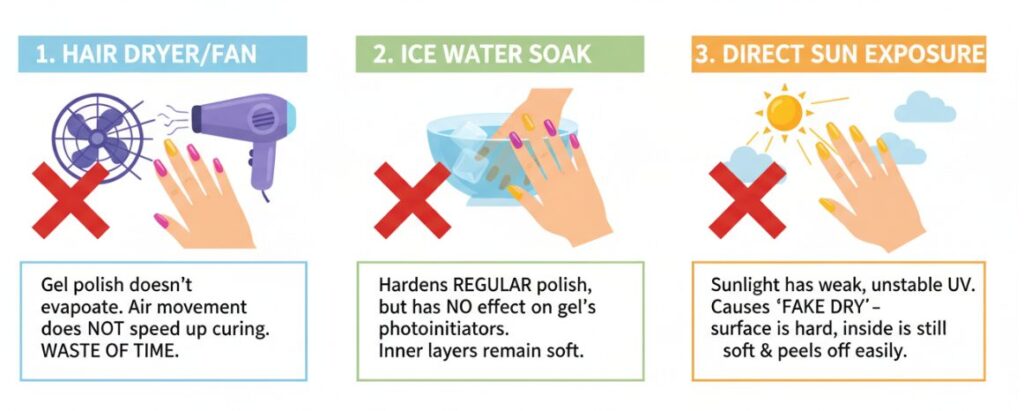
This is the most misunderstood nail novice place. Many people feel that the lamp is still sticky after touching it. They think it is not dry and even suspect that the lamp is broken.
In fact, this is called oxygen inhibition layer, commonly known as floating glue in the industry. During the curing process, the oxygen in the air will prevent the most surface layer of glue from completely polymerizing. Therefore, leaving a layer of sticky residue on the surface of the nail is a very normal phenomenon.
If you feel that it is not dry and put it back into the deadly light, it will cause the nail polish to overload and harden, making it easy to crack. The handling method is simple:
Finally, after applying the seal layer for enough time, wipe it 1 times with 91% or more isopropyl alcohol (clean water), and the high gloss will come out immediately.
Or directly use No-Wipe Top Coat, this product has been specially improved for oxygen problems, and it is dry directly after being taken.
Author: Emma Roberts
As a professional nail technician and beauty educator with over eight years of experience in the salon industry, I’ve helped thousands of clients achieve the perfect, long-lasting manicure. I am passionate about de-mystifying the chemistry behind nail technology—like the fascinating process of polymerization—to help DIY enthusiasts avoid common mistakes and get salon-quality results at home.