 FSM-Nail


Search the entire website
Search
Search the entire website
Generally speaking, if it is unopened and properly stored, the shelf life is about 24 to 36 months. But once you unscrew the cap, this period is usually shortened to 12 to 18 months-depending on the brand’s formula and your storage environment, of course.
Many novices are easily confused: ordinary nail polish deteriorates because of “air drying”, while gel polish is sensitive to light. Therefore, the key to determining the length of its life is not air, but how much ultraviolet (UV) or LED light and heat it is exposed.
If you want to know the exact life of the bottle of glue on hand, the most direct way is to look at the “shelf life after opening” (PAO) mark on the bottle. That’s an icon with a small jar with an open lid, with “12M” or “24M” next to it, which means how many months the product is stable and safe once the seal is broken.
The state of the bottle is the biggest variable in determining the life of the polish.
Unopened shelf life (24-36 months):
Shelf life after opening (12-18 months):
Ordinary nail polish thickens because the solvent evaporates into the air; but gel polish is different, its enemies are light and heat.
This means that the photo-initiators in the glue-the same ingredient that hardens the glue under the lamp-could be activated by sunlight or even intense indoor lighting. If you throw the bottle by the window or in a stuffy room, a slow “curing” process will occur in the bottle.
Over time, the liquid will thicken, agglomerate, and even semi-solidify. Once this chemical polymerization reaction occurs in the bottle, it is completely irreversible.
The formula of different brands varies greatly (some colloids are thicker, some photoinitiators are higher). At this time, the label is particularly important.
Please check the back or bottom of the bottle for the PAO logo:
This mark represents the commitment of the manufacturer. It indicates that the preservative and chemical stability of the product have been tested and can maintain normal performance during the period after opening. I don’t recommend extended use, because it may lead to light dry, skin allergy or easy to become warped and fall off.
The so-called “proper preservation” is actually the only variable that determines how long your bottle of glue will live. Even if the bottle says “24M”, if it is badly preserved, it will be spent in a few weeks.
If you want your nail polish to live longer in the bottle, please follow the following principles:
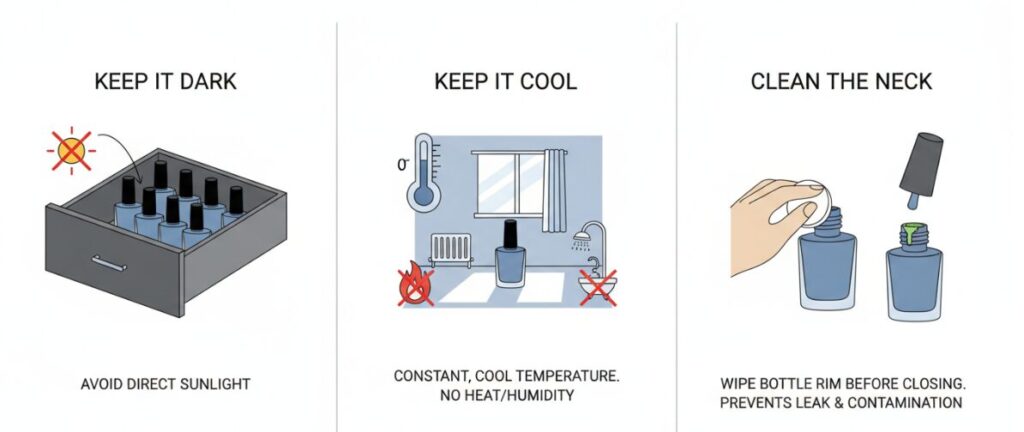
As long as you follow these storage principles and respect the PAO date, you can maximize the life of the nail polish and ensure that the quality of the nail art is online every time.
The most obvious indicator is the texture of the liquid. Because polish gels are sensitive to light, expired or improperly stored gels often become sticky, clumpy, or stringy due to slow polymerization inside the bottle. If the formula has been severely stratified, it still doesn’t work after shaking well, or it has exceeded the 12 to 18 month deadline on the PAO logo, listen to my advice and throw it away.
I do not recommend doing this. The PAO symbol (e. g., “24M”) is a time window for manufacturers to ensure that products are chemically stable and safe. Long-term use may lead to performance problems, such as premature peeling of the gel or failure to fully cure under UV/LED lights. More seriously, chemically unstable products can trigger skin irritation or allergic reactions-a big no-no in the professional world.
If the glue hardens or thickens in the bottle, there is a high probability of exposure to UV/LED light or overheating. This is different from ordinary nail polish air drying. The nail polish is cured by light. If the bottle is placed by the window, under a strong desk lamp, or stored in a high temperature environment, the curing process will start quietly in the bottle, and this life loss is irreversible.
Yes, even if it is not opened, it has a guarantee period. Although no contact with air can maintain a certain degree of stability, but the chemical composition will not last forever. Typically, unopened nail polish can be stored for 24 to 36 months in a cool, dark place. After this time, the ingredients may delaminate or degrade, and even if the seal is intact, it may no longer be usable.
Author: Sarah Jenkins
“With a passion for nail technology and product chemistry, I specialize in helping you maximize the value of your manicure kit. In this article, I explain why gel polish is uniquely light-sensitive compared to regular lacquer and how to interpret the ‘PAO symbol’ on your labels. “