 FSM-Nail


Search the entire website
Search
Search the entire website
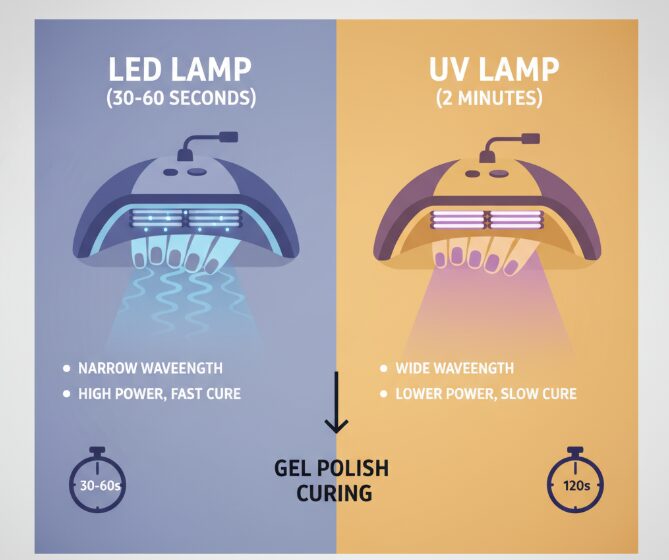
The curing time is 30 to 60 seconds under an LED lamp, or 2 minutes (120 seconds) under a UV lamp for each coat.
However, after lighting the light, the nail surface will still feel a little sticky. This does not mean that the nail polish is not dry; this is actually a very normal chemical reaction, we call this jargon “floating glue”.
Remember, never touch or try to wipe off this sticky float with your hands until you have applied the last layer of sealing and dried.
In addition, for some dark colors, such as pure black or crimson, experienced nail therapists will recommend that you double the lighting time. This is done to prevent surface wrinkling due to incomplete internal solidification of the colloid.
Which lamp you use is the most central variable in determining curing time. The difference in time window between the two technologies is quite large.
LED Lamps (30-60 Seconds): The wavelength range of light emitted by LED lights is narrower and more targeted. Because the energy output is very concentrated, the photoinitiator in the polish can be activated more quickly. For most standard coatings (such as primers, colorants, and seals), an irradiation period of 30 to 60 seconds is sufficient to allow the polymer to harden.
UV Lamps (2 Minutes): The spectral range of traditional ultraviolet lamps is much wider, but the output intensity is usually lower. As a result, they require longer irradiation times—typically 120 seconds per layer—to achieve the same degree of polymerization cure.
Be sure to pay attention to the specific power (wattage) of your nail lamp. Although the 30-60 second rule is a general rule in the industry, this rule mainly applies to standard power LED lights. If you are using a low-power portable travel lamp, the curing time may need to be extended slightly to ensure insurance.
One of the most common mistakes beginners make is checking if the gel is cured by touching it. If you touch the nail after the recommended 30-60 seconds (LED) or 2 minutes (UV), it will feel tacky. This does not mean the polish is under-cured.
This sticky substance is the “floating glue” we mentioned earlier. It is due to the nail polish in the curing process; the surface layer comes into contact with oxygen in the air, resulting in a very thin, not fully cured gel.
The existence of this layer of floating glue has a practical function: it is like a layer of double-sided glue, which can help you apply the next layer of nail polish glue to adhere more firmly to the previous layer.
What strictly to avoid: In the process of brushing the bottom glue and color glue, absolutely, absolutely do not wipe off the floating glue produced in the middle. Once wiped off, it is likely to cause subsequent nails to be easily warped or delaminated.
When to wipe: Only after you have applied the last layer of sealing layer and cured by the light, can you wipe the nail surface with an alcohol cotton pad or a special gel cleaner (provided that you use a “scrubbing sealing layer” that needs to be removed).
When we deal with colors with high saturation and high pigment content, the standard answer of “how long does the nail polish take?” will change slightly.
Colors such as pure black, deep wine red, navy blue, or dark green contain very dense pigment particles inside. These particles will act like a sunshade, blocking light from penetrating to the bottom of the polish gel.
If you only take a standard 30 seconds to take a black nail polish, the result is likely to be a hardened layer on the surface, but the underlying gel close to the nail is actually still liquid. This can lead to two very bad consequences:
Wrinkling: When the hardened surface shrinks, it will squeeze the liquid colloid below to “peel” and form ugly ripples.
Under-curing: The liquid gel that is “stuffy” between the nail and the hardened surface layer is not only easy to cause the entire nail art to become warped later but may even cause skin allergic reactions.
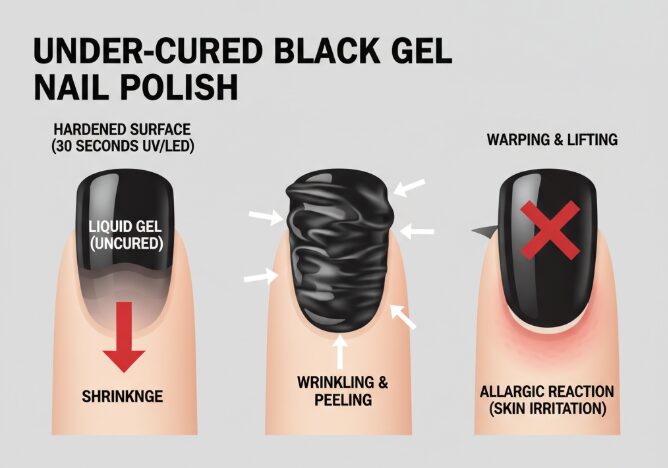
To avoid this, double the curing time directly when dealing with these special colors. If you are used to lighting for 60 seconds at ordinary times, then when making pure black or similar colors with heavy pigments, extend it to 120 seconds to ensure that the light can completely penetrate the entire gel matrix and let it cure thoroughly from inside to outside.
Author:Chloe
I’m a dedicated nail enthusiast and researcher specializing in gel manicure techniques. With years of experience testing various LED and UV lamp technologies, I focus on the science behind perfect curing. I hope to help you achieve salon-quality results by understanding the critical details—like inhibition layers and curing ratios—that ensure a long-lasting, flawless finish.