 FSM-Nail


Search the entire website
Search
Search the entire website
The working principle of gel nail polish is mainly based on a chemical chain reaction called “polymerization. In simple terms, every bottle of nail polish is mixed with liquid molecules-that is, monomers and oligomers , as well as key chemical components that are sensitive to light, called photoinitiators. When you expose your gummed nails to specific wavelengths of UV or LED lights, these photoinitiators absorb energy and instantly trigger the curing process. This process converts the liquid formula into a hard and durable plastic mesh structure through “cross-linking”, which is why the phototherapy armor can be maintained for several weeks without easily warping or falling off.
To really understand how nail polish turns from liquid to solid, we have to look at its molecular makeup. The core components are monomers and oligomers. Monomers are small, independent molecules that you can think of as the basic “bricks” that make up the gel “. They are mainly responsible for giving the nail polish fluidity so that you can smoothly apply it to the nail surface during operation. Oligomers are slightly larger and are formed by connecting several monomer units. They form the “body” of the gel, which determines the viscosity of the gel and whether the final nail has good toughness and gloss. In the bottle, as long as it is protected from light, these molecules will float freely past each other, which is why the gel can always remain liquid.
This is the photosensitive compound specifically designed to react to electromagnetic radiation. The photoinitiator acts as a “start switch” for the entire chemical reaction “. Each type of polish contains a specific photoinitiator and is designed to absorb only a precise wavelength of energy. This is why the phototherapy glue must be matched with a special curing lamp, which can never be dried by placing it in the natural air alone.
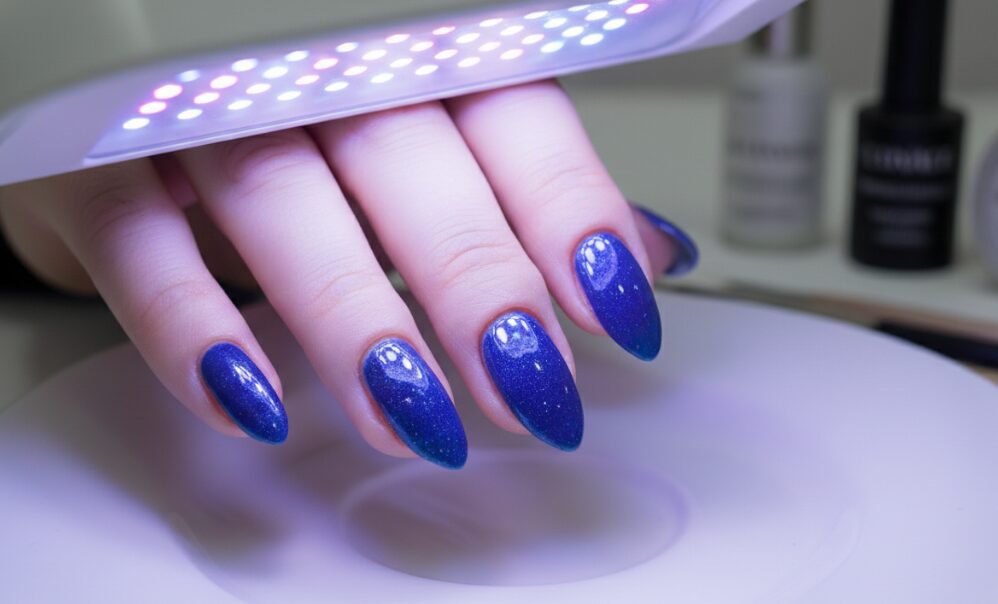
The so-called “curing process” describes the moment when the chemical reaction begins. When you put your hand under a UV or LED light, the device emits a specific wavelength of light (usually between 340nm and 405nm).
Energy absorption: The photoinitiator in the gel layer absorbs this light energy.
Activation: After absorbing energy, the photoinitiator is activated and decomposed to produce free radicals.
Chain reaction: These free radicals will violently collide with monomers and oligomers, forcing them to bond together quickly.
Tips: the intensity and wavelength of the lamp must match the requirements of the photoinitiator in the glue. If the wavelength is not matched, the photoinitiator cannot be activated, and the result is that the colloid is not dry, or in a semi-liquid “pseudo-dry” state.
This reaction triggered by light is called a polymerization reaction. At this stage, the originally independent monomer and oligomer molecules hand in hand to form a long chain, that is, polymer. However, the light forming chain is not enough to create the rock-solid surface of the light therapy armor. The whole process needs to go further, through cross-linking to complete the qualitative change.
Network effect: Cross-linking refers to the lateral connection between these long polymer chains, woven into a tight three-dimensional “network”.
Plasticization Transformation: This dense net completely locks the liquid formula into a hard solid plastic structure.
Author: Elena Ross
“As a cosmetic chemist with over 10 years of experience in product formulation, I specialize in the science behind beauty. I’m passionate about deconstructing complex chemical reactions—like polymerization and cross-linking—to help you clearly understand exactly how your manicure works.”